

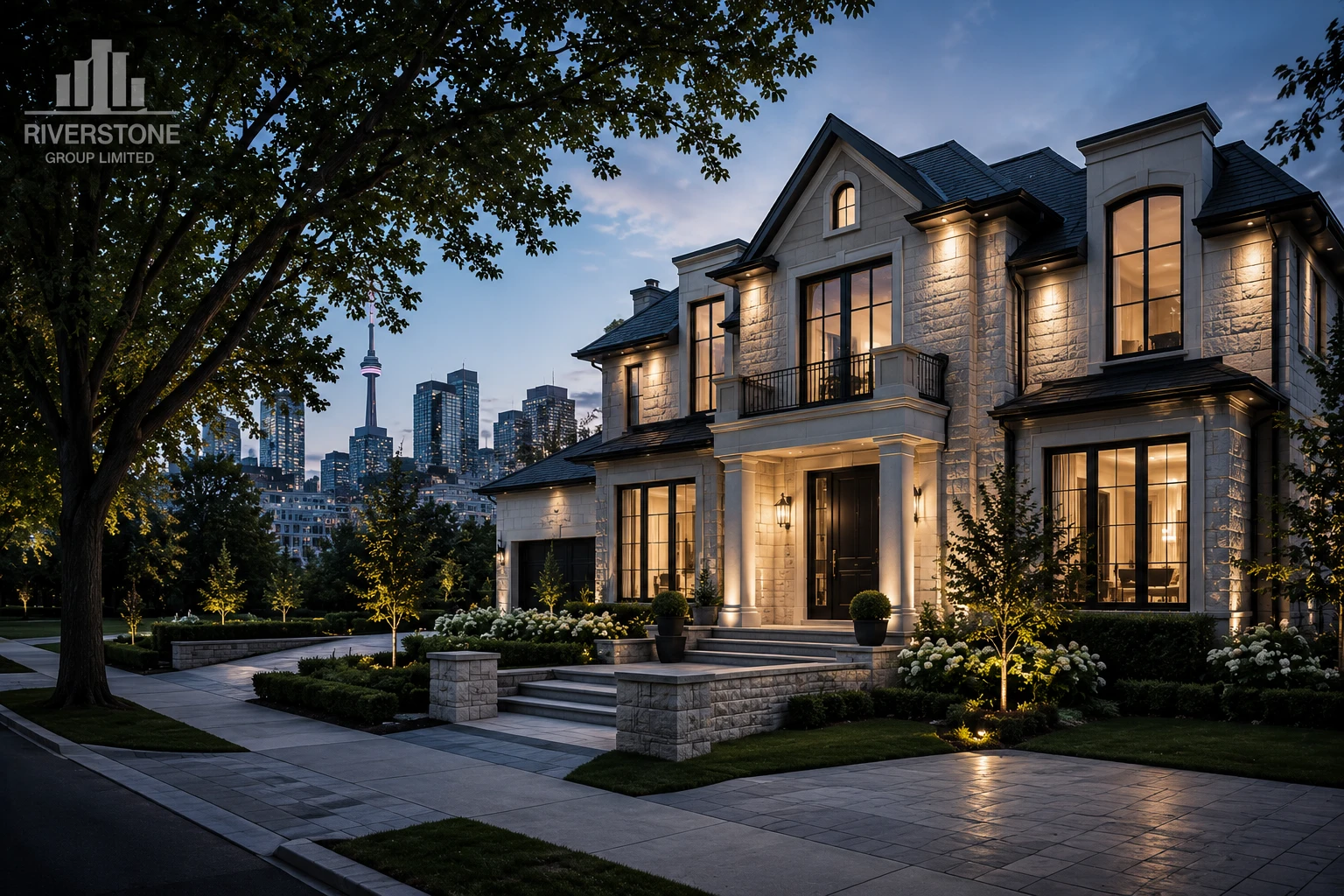
There is a point in the life of a Toronto property owner when the question changes.
It is no longer simply, “Where should we live?”
Instead, it becomes:
For homeowners considering a custom residence in Rosedale, Forest Hill, or elsewhere in Toronto and the GTA, that decision involves much more than comparing the cost of construction with the expected selling price of the finished home.
The property itself matters. So does the neighbourhood. The design matters. So does the engineering. Construction quality matters, as do the decisions made before construction even begins.
And there is another consideration that is particularly important at the luxury end of the market: a custom home is both a place to live and a significant long-term asset.
That does not mean a custom home is automatically a good financial investment. It certainly does not mean future appreciation can be guaranteed.
What it does mean is that a well-conceived custom home can give an owner an unusual degree of control over the quality, functionality and long-term appeal of a major real-estate asset.
For Riverstone Group, that intersection is central to the way we approach custom residential construction. The firm’s Principal team brings together architectural expertise, Professional Engineering and residential real-estate knowledge, with detailed budgets and personal involvement throughout the project.
So, is building a custom home still a good investment in Toronto?
For the right property, the right homeowner and the right project, it can be. But the investment case begins well before construction starts.
The Better Question Is Not “Will My House Go Up in Value?”
Anyone considering a significant real-estate investment naturally wants to know what the property might be worth in the future.
But predicting a future selling price is not the most useful way to evaluate a custom home.
Toronto’s housing market will continue to move through different cycles. Interest rates, economic conditions, buyer preferences, construction costs and government policies will all change over the life of the property. The Bank of Canada currently has its overnight target at 2.25%, and its July 2026 outlook continues to describe meaningful economic uncertainty.
Those conditions are relevant, particularly when financing a major project.
They are not, however, the factors a homeowner can control.
The more productive question is:
What can I do today to create a property that remains desirable, functional and well-positioned over the long term?
That starts with the land.
It continues through architecture and engineering.
And it ultimately comes down to the quality of the finished home.
Start With the Property, Not the Floor Plan
One of the most consequential decisions in a custom-home project can happen before an architect draws the first line.
It is the decision to buy—or retain—the property on which the house will be built.
Toronto’s established neighbourhoods are valuable partly because the land itself is scarce. A property in Rosedale, Forest Hill or Lawrence Park cannot simply be replicated somewhere else. The same principle applies in other established GTA communities and in destinations such as King Township and the Muskokas, where Riverstone also works with clients.
But two properties in the same neighbourhood can have very different development potential.
A site assessment should consider things such as:
- Lot dimensions and configuration
- Existing structures
- Setbacks
- Zoning
- Access
- Grading and drainage
- Mature trees
- Privacy
- Orientation
- Natural light
- Neighbouring buildings
- Potential basement depth
- Servicing
- Easements and other property constraints
- The likely relationship between the finished house and the surrounding streetscape
These details can influence both the cost of construction and the quality of the eventual residence.
A property that looks attractive from the street may present significant limitations once its development potential is examined. Conversely, a house that appears ordinary today may sit on an exceptional piece of land with considerably more potential.
This is one of the reasons Riverstone’s combination of construction expertise and residential real-estate knowledge is important during the early stages of a project. The question is not simply what can be built. It is what makes sense to build on that particular property.
In Toronto, Context Matters
A custom home should belong to its setting.
That does not mean every new residence needs to imitate the houses around it. Good architecture can introduce contemporary ideas and still feel appropriate to an established neighbourhood.
What matters is proportion, scale, materiality, streetscape and the relationship between the house and its site.
A residence in Summerhill may need a very different response from one in King City.
A Forest Hill project may be shaped by mature trees, neighbouring houses and a relatively constrained urban lot. An estate property outside the city may provide considerably more freedom to work with landscape, views and outdoor spaces.
Riverstone’s experience across Toronto’s established neighbourhoods—from Rosedale, Summerhill and Forest Hill to Lawrence Park, Moore Park, Yorkville, Leaside and The Kingsway—is therefore more than a list of service locations. It provides context for understanding how different properties need to be approached.
For an investment-conscious homeowner, that context matters.
A house should be impressive on its own terms, but it should also make sense within the market around it.
Good Architecture Has a Longer Shelf Life Than a Trend
Luxury residential design can be particularly vulnerable to trends.
A certain stone becomes fashionable. Then a particular kitchen style. Then a new exterior treatment. Then another.
A custom home, however, is rarely a two- or three-year purchase.
If the intention is to own a residence for 10, 15 or 20 years, the architecture needs to have considerably more staying power.
That does not mean designing something bland.
It means putting the emphasis on things that tend to remain valuable:
- Strong proportions
- Natural light
- Considered circulation
- Meaningful connection between rooms
- Quality materials
- Well-resolved exterior architecture
- Useful outdoor spaces
- Appropriately scaled rooms
- Privacy
- Storage
- Flexible spaces
- Thoughtful transitions between public and private areas
Riverstone’s current design work reflects this emphasis on homes that combine personal character with long-term functionality and investment awareness. The firm’s own 2026 discussion of Toronto luxury-home design highlights a shift away from purely aesthetic statements toward architecture that considers wellness, technology, functionality and longevity.
That is a more durable way to think about luxury.
The objective is not to create a house that looks expensive today.
It is to create a house that still feels exceptionally well considered years from now.
More Square Footage Is Not the Same as More Value
This is particularly relevant in Toronto’s luxury market.
It is easy to assume that adding another 1,000 square feet must make a property more valuable.
The reality is more nuanced.
Additional space has construction, heating, cooling, maintenance and property-tax implications. More importantly, it needs to serve a purpose.
A well-designed 6,000-square-foot home can be more compelling than an unnecessarily large 9,000-square-foot residence if the smaller home has:
- Better natural light
- Better circulation
- Stronger connection to the garden
- More useful living spaces
- Better bedroom separation
- More intelligent storage
- A more successful relationship with the lot
- Better proportions
- Higher-quality detailing
This is where design discipline becomes part of investment discipline.
The question should not be:
“How much house can this lot hold?”
It should be:
“What is the right house for this property?”
That distinction can have a substantial effect on both the experience of living in the home and its eventual market appeal.
Engineering Is Part of the Value Proposition
Many homeowners first encounter engineering as part of the permit process.
For a serious custom-home project, it should be involved much earlier.
Structural decisions affect the architecture. The architecture affects structural requirements. Mechanical systems affect ceiling heights and service spaces. Window sizes affect structure and energy performance. Basement design affects excavation and waterproofing. Site drainage affects both construction and long-term performance.
These things are interconnected.
Ontario’s current Building Code is based on the National Building Code of Canada 2020 with Ontario amendments, with the applicable regulation updated during 2026.
For new houses and material alterations in Toronto, the City also requires engineering responsibility in applicable permit documentation; Toronto’s current permit guidance specifically addresses the Professional Engineer’s seal and assumption of responsibility for engineering content.
But meeting the Code is only the starting point.
For a high-value residence, engineering should contribute to the broader objective of creating a home that performs well over time.
That includes consideration of:
- Structure
- Foundations
- Waterproofing
- Drainage
- Building envelope
- Thermal performance
- Moisture management
- Mechanical coordination
- Durability
- Large openings and architectural features
Riverstone’s decision to have Professional Engineering represented within its Principal team is therefore central to its model rather than an administrative afterthought.
For an owner committing substantial capital to a residence, that distinction is meaningful.
The Invisible Parts of a Luxury Home Can Protect Its Value
Some of the most important features in a house are not the ones guests notice first.
They are behind the walls.
They include:
- Insulation
- Air sealing
- Waterproofing
- Drainage
- Structural connections
- Mechanical distribution
- Electrical infrastructure
- Ventilation
- Window installation
- Roofing details
These elements rarely appear in a marketing photograph.
They can, however, influence comfort, maintenance and durability for years.
Toronto’s climate makes this particularly important. A custom home needs to perform through winter cold, summer heat, precipitation and repeated seasonal changes.
A luxury finish package cannot compensate for poor underlying construction.
For this reason, investment-conscious homeowners should evaluate a builder’s technical capabilities with the same seriousness they apply to architectural design.
The Financial Equation Is Larger Than Construction Cost
One of the easiest ways to misunderstand a custom-home investment is to compare:
Land Cost + Construction Cost
with
Future property value.
The actual project economics can involve considerably more:
- Land acquisition
- Land transfer tax
- Legal fees
- Design and architectural fees
- Engineering
- Surveying and consultants
- Municipal fees
- Demolition
- Excavation
- Construction
- Financing
- Insurance
- Temporary accommodation
- Landscaping
- Furnishings
- Contingency
- Carrying costs
- Taxes and applicable HST considerations
The point is not to make the project sound complicated.
It is to make the financial decision realistic.
Riverstone’s stated approach includes detailed, itemized budgets at each stage so clients can understand where their investment is going. That is particularly important on a custom project, where decisions made during design can have significant downstream cost implications.
For a homeowner, budget transparency should not simply mean knowing what the project costs.
It should mean understanding why it costs that amount and what alternatives exist.
The Financial Equation Is Larger Than Construction Cost
One of the easiest ways to misunderstand a custom-home investment is to compare:
Land Cost + Construction Cost
with
Future property value.
The actual project economics can involve considerably more:
- Land acquisition
- Land transfer tax
- Legal fees
- Design and architectural fees
- Engineering
- Surveying and consultants
- Municipal fees
- Demolition
- Excavation
- Construction
- Financing
- Insurance
- Temporary accommodation
- Landscaping
- Furnishings
- Contingency
- Carrying costs
- Taxes and applicable HST considerations
The point is not to make the project sound complicated.
It is to make the financial decision realistic.
Riverstone’s stated approach includes detailed, itemized budgets at each stage so clients can understand where their investment is going. That is particularly important on a custom project, where decisions made during design can have significant downstream cost implications.
For a homeowner, budget transparency should not simply mean knowing what the project costs.
It should mean understanding why it costs that amount and what alternatives exist.
Toronto’s Tax and Regulatory Environment Deserves Professional Attention
A custom home is a substantial financial undertaking, and Canadian tax treatment should be considered before the project is structured.
This is not an area where homeowners should rely on generic internet advice.
Land Transfer Tax
Ontario’s Land Transfer Tax applies when land is acquired. For qualifying one- or two-single-family-residence properties, the provincial rate increases to 2.5% on the portion of consideration above $2 million.
Toronto also has its own Municipal Land Transfer Tax, so a Toronto acquisition needs to be evaluated with both taxes in mind.
The applicable amount depends on the transaction and should be calculated by the homeowner’s legal and tax advisors.
HST
GST/HST treatment can also be relevant to new construction and substantially renovated residences.
Canada’s current housing-rebate framework includes the existing GST/HST New Housing Rebate and a new first-time home buyer GST/HST rebate. The latter can provide a full federal GST rebate for eligible first-time buyers on qualifying new homes up to $1 million and a reduced rebate for homes between $1 million and $1.5 million, subject to the detailed eligibility requirements. Ontario also has a provincial first-time home buyer rebate of up to $80,000.
For most established luxury-home buyers considering a custom project, those first-time-buyer provisions may not apply. That is precisely why the project’s tax position should be reviewed individually rather than assuming a rebate exists.
Principal residence versus build-to-sell
This distinction is especially important.
The CRA states that a property that qualifies as a principal residence can receive the principal residence exemption subject to the applicable rules and reporting requirements.
However, the CRA also specifically identifies “buying to build and sell” as a situation where the resulting profit can be treated as business income rather than receiving principal-residence treatment.
That means a homeowner who is genuinely building a family residence should not assume the same tax treatment applies to someone acquiring land, building a house and selling it for profit.
For a custom-home project, a Canadian tax advisor and real-estate lawyer should review the ownership structure, intended use and transaction before commitments are made.
Permitting Is Part of the Investment Decision
The City of Toronto’s current process requires applicants to consider zoning and other applicable law, select the appropriate permit guide, provide the required documentation and pay applicable fees. Toronto maintains specific guides for new houses and residential demolition permits associated with replacement buildings.
This matters before construction—not after the property has been purchased.
A homeowner should understand what the site can reasonably support before assuming that a particular design is achievable.
Toronto also distinguishes between complete and incomplete permit applications. The City’s current review-stream guidance states that complete applications are reviewed within the applicable service standard, while incomplete applications do not have a defined review timeframe.
For a custom build, that reinforces an important principle:
Preparation is part of project management.
The more thoroughly the property, zoning, design, engineering and applicable approvals are understood before submission, the fewer surprises are likely to emerge later.
The Most Valuable Custom Features Are Usually the Ones People Actually Use
Luxury does not have to mean extravagance.
For many homeowners, the most valuable improvements are surprisingly practical.
A kitchen that genuinely works for the family.
A mudroom that handles daily life.
A primary suite that provides privacy.
A home office that feels like a proper workspace rather than an afterthought.
A lower level with natural light and useful programming.
A garden room that connects naturally to the landscape.
A garage with enough storage.
A mechanical system that is quiet.
Lighting that changes naturally through the day.
Technology that works without becoming the centrepiece of the house.
These details contribute to the experience of ownership.
And because they address how people actually live, they can also have broader appeal than highly specialized features designed around a single owner’s preferences.
Personalization Is Important. So Is Restraint.
A custom home should feel personal.
Otherwise, there is little reason to build one.
But personalization can become counterproductive when it overwhelms the underlying architecture.
A future buyer may not share the current owner’s taste in:
- Bold colours
- Highly specialized rooms
- Unusual layouts
- Dramatic architectural features
- Elaborate built-ins
- Technology platforms
- Themed spaces
This does not mean every decision should be made for an imaginary future buyer.
It means the home’s permanent elements should have enough design integrity to survive changes in taste.
A useful principle is to personalize the things that are easy to change while investing more carefully in the things that are difficult or expensive to alter.
That might mean expressing personality through furniture, lighting, art, textiles and selected finishes while keeping the fundamental planning and architecture timeless.
What About Energy Efficiency?
For a modern Canadian luxury residence, energy performance is becoming increasingly difficult to separate from quality.
The discussion should extend beyond purchasing efficient appliances.
It begins with the building itself.
A well-considered approach can look at:
- Orientation
- Glazing
- Insulation
- Air tightness
- Thermal bridging
- HVAC selection
- Ventilation
- Controls
- Zoning
- Water heating
- Lighting
- Renewable-energy opportunities where appropriate
The right combination depends on the property and design.
The goal is not to add technology for the sake of having technology. It is to create a house that performs intelligently.
This can improve comfort and operating efficiency while also making the residence more relevant to future buyers who increasingly consider the ongoing cost and performance of a property.
Custom Home or Existing Luxury Home?
There is no automatic financial winner.
Buying an existing luxury property can be the more sensible option when the location, architecture and condition are already right.
It can offer:
- Immediate occupancy
- Known construction
- Established landscaping
- Less project uncertainty
- A clearer purchase price
A custom build becomes more compelling when the available resale properties cannot provide the combination of location, layout, architectural quality and functionality the homeowner wants.
There is also a third option that deserves serious consideration in Toronto:
Renovate rather than rebuild.
An existing house may contain architectural character, mature landscaping or structural elements worth preserving. In another case, the structure may be so constrained that attempting to transform it becomes inefficient.
The right answer depends on the specific property.
That is why the feasibility conversation should happen before the design direction is locked in.
When Does a Custom Home Make the Most Sense?
There are several circumstances in which the case for building becomes particularly strong.
You already own an exceptional property
If the land is difficult to replace and the existing house does not meet your needs, rebuilding can unlock the value of the site.
You cannot find the right home on the resale market
Sometimes the combination you want simply does not exist.
You plan to stay for many years
The longer you expect to own the property, the more meaningful the lifestyle and functional benefits become.
The existing home is fundamentally inefficient
A major renovation can sometimes approach the complexity of a new build without delivering the same freedom of planning.
You care deeply about architecture and detail
A custom build provides control that an existing home cannot.
You want the home to work around your life
This is perhaps the strongest reason of all.
The home can be designed around the way your family actually lives rather than adapting your life around someone else’s floor plan.
When Should You Be More Cautious?
There are also situations where a custom build deserves a harder look.
Be cautious when the project depends on a very optimistic future selling price.
Be cautious when the proposed house would be substantially larger or more expensive than comparable properties in the area.
Be cautious when the budget is based on early estimates without sufficient design development.
Be cautious when the site has unresolved zoning, servicing or physical constraints.
And be especially cautious if the project is being considered primarily as a short-term flip.
The CRA specifically identifies buying land and building a property for resale as a potential business-income situation.
A custom home intended as a long-term family residence is a fundamentally different proposition from a build-to-sell project.
The Builder Becomes Part of the Investment Strategy
Once the decision to build has been made, the choice of builder can materially affect the outcome.
Not simply because of workmanship.
Because of decision-making.
A custom project contains an enormous number of interconnected choices. A change in one area can affect another. A design decision can affect engineering. A material choice can affect procurement. A procurement delay can affect sequencing. A late change can affect cost.
The builder therefore becomes part of the system through which the owner’s capital is converted into a finished asset.
This is one reason Riverstone deliberately operates at boutique scale.
The company states that its Principals remain personally involved throughout the project, rather than passing responsibility through a large organizational structure. Its model brings architects, engineering expertise and residential real-estate knowledge together under one project leadership structure.
For a homeowner undertaking a high-value project, that continuity can matter.
The person discussing the property at the beginning should understand why a particular design decision was made when that decision reaches construction.
Why Riverstone’s Three Disciplines Matter
Riverstone’s positioning can be reduced to three connected disciplines:
Architecture
The house needs to be beautiful, considered and appropriate to its setting.
Engineering
It needs to be structurally sound and technically resolved.
Market Intelligence
It needs to be informed by an understanding of what makes residential property desirable and valuable.
The important point is that these are not three separate services.
They influence one another.
An architect may propose an extraordinary opening.
Engineering determines how it can be executed.
Market knowledge helps assess whether the resulting space improves the home’s broader appeal.
A client may want a highly specialized feature.
The design team can determine how to incorporate it without compromising the overall plan.
A particular site may support a larger house.
The real-estate perspective asks whether that additional construction actually makes sense.
That is the kind of thinking Riverstone means by “Architecture. Engineering. Market Intelligence.”
The Importance of Knowing What Things Cost—and What They Are Worth
This is perhaps the clearest distinction between simply building a house and managing a significant residential investment.
Knowing the construction cost of a feature is one thing.
Understanding whether that feature is worth building is another.
A premium imported stone may be beautiful.
But is it the right stone for the house?
A larger basement may be possible.
But will it improve the home enough to justify the additional excavation and finishing costs?
A dramatic roofline may create architectural impact.
But does it contribute to the overall design or simply increase complexity?
An additional 1,500 square feet may sound attractive.
But will the homeowner use it?
These are not questions that a construction estimator can answer in isolation.
They require architecture, engineering, construction knowledge and an understanding of the local residential market.
That integrated perspective is one of the reasons Riverstone describes its approach as being both personally meaningful and financially sound.
What Should a Homeowner Evaluate Before Starting?
Before committing to a custom build, I would encourage homeowners to have a serious conversation around five areas.
The property
What can this site realistically become?
The programme
What does the household actually need from the home?
The architecture
What design direction will remain compelling for years?
The construction
What level of technical quality and craftsmanship is required?
The financial model
What is the total project investment, and does it make sense relative to the property and the surrounding market?
Those questions should be answered before the project becomes emotionally attached to a particular design.
That is where an experienced builder can add value early—not by pushing the project toward construction, but by helping determine whether the project makes sense in the first place.
A Different Way to Think About Return on Investment
For a custom residence, return should not be viewed solely as:
Purchase price → construction cost → resale price.
There are several forms of return.
Financial return
The potential future value of the property relative to the total investment.
Functional return
How effectively the home serves the family’s needs.
Lifestyle return
The quality of living the home provides over the years it is occupied.
Durability return
The benefit of investing in construction that performs properly rather than requiring premature correction or replacement.
Flexibility return
The ability of the house to adapt as the family’s needs change.
A homeowner planning to stay for 15 years may place considerably more weight on the latter four than someone planning to sell after three years.
And that is perfectly rational.
A home is not a stock certificate.
It is an asset that is simultaneously occupied, experienced, maintained and eventually transacted.
So, Is It Still a Good Investment?
For the right Toronto property, yes—but not because custom homes are guaranteed to appreciate.
The stronger argument is that a well-executed custom home gives the homeowner the opportunity to control many of the factors that contribute to long-term residential value.
You can choose the site.
You can determine the plan.
You can influence the architecture.
You can insist on proper engineering.
You can select materials based on durability rather than fashion.
You can plan the mechanical systems.
You can control how the house relates to the landscape.
You can decide where to spend and where not to spend.
And you can work with a builder whose role extends beyond coordinating trades to helping make informed decisions throughout the process.
What you cannot control is the future Toronto market.
No reputable builder should promise a particular future return.
But you can control the quality of the asset you create.
That is ultimately the more responsible investment strategy.
Build for the Life You Want—and the Property You Want to Leave Behind
The strongest reason to build a custom home is not speculation.
It is that you have found a property worth staying on and want to create something that could not be bought off the shelf.
If that home is designed intelligently, engineered properly, built with discipline and suited to its neighbourhood, the result can be much more than a personal expression.
It can be a highly considered piece of real estate.
At Riverstone Group, that is the standard we believe a custom home should be held to.
Beautiful enough to be deeply personal.
Intelligent enough to perform.
Disciplined enough to respect the investment.
And considered enough to remain relevant long after current trends have passed.
For homeowners considering a custom build in Toronto, the first conversation should therefore not be about choosing finishes.
It should be about the property, the opportunity, the objectives and whether building is genuinely the right decision.
That is where a successful custom home begins.
Thinking About Building a Custom Home in Toronto?
Riverstone Group works with homeowners across Toronto’s established neighbourhoods, the GTA, King Township and the Muskokas, bringing together architecture, Professional Engineering, interior design, construction management and residential real-estate knowledge under a boutique model.
If you are considering a custom build, teardown and rebuild, or transformative renovation, an early conversation can help establish what the property can support, what the project may involve and where the greatest opportunities—and risks—may lie.
Thinking About Building a Custom Home in Toronto?
Start with the property. Start with the vision. Then determine what is worth building.
Riverstone Group — Toronto & GTA — riverstonegroup.net
Frequently Asked Questions About Building a Custom Home in Toronto
Is building a custom home in Toronto a good investment?
A custom home can be a strong long-term real-estate asset when the property, design, construction quality and overall investment are carefully considered. However, appreciation cannot be guaranteed. The investment case depends on factors such as location, land value, neighbourhood context, design quality, construction standards and the homeowner’s intended holding period.
Is it better to build a custom home or buy an existing luxury home?
There is no universal answer. Buying an existing home can provide faster occupancy and greater cost certainty, while a custom build allows the homeowner to control the architecture, layout, materials, systems and functionality. The right choice depends on the property available, the homeowner’s objectives, budget and expected length of ownership.
Does a custom home have better resale value?
Not necessarily. A well-designed custom home in an appropriate location can have strong resale appeal, but customization alone does not guarantee higher value. Homes tend to have broader appeal when their architecture, floor plan, materials and amenities are appropriate for their neighbourhood and remain functional beyond current design trends.
How much does it cost to build a luxury custom home in Toronto?
There is no reliable single price per square foot that applies to every luxury project. Costs can vary substantially based on the property, demolition, excavation, structural requirements, architectural complexity, size, mechanical systems, finishes, landscaping and level of customization. A detailed project budget should be developed after the property and scope are properly assessed.
How long does it take to build a custom home in Toronto?
A high-end custom home can take roughly 18–30 months or more from early planning through completion, depending on design complexity, approvals, procurement, site conditions and construction scope. The construction phase itself can take approximately 12–18 months or longer for more complex residences.
How do I choose the right custom home builder in Toronto?
Look beyond the construction price. Consider the builder’s experience with comparable projects, design and engineering capabilities, project-management approach, budget transparency, communication, local knowledge, quality-control processes and level of Principal involvement. For a high-value custom home, the relationship and decision-making process can be as important as the construction itself.
Important Note: This article is intended for general informational purposes only and does not constitute financial, investment, legal, tax, accounting, mortgage, real-estate or construction advice. Real-estate values, construction costs, financing conditions, municipal requirements and tax legislation can change. References to Canadian and Ontario rules are provided as general context and should not be relied upon for a specific transaction. Homeowners should obtain advice from appropriately qualified Canadian professionals—including a real-estate lawyer, tax advisor/accountant, mortgage professional and real-estate or appraisal professional—before making financial, ownership, tax or investment decisions.